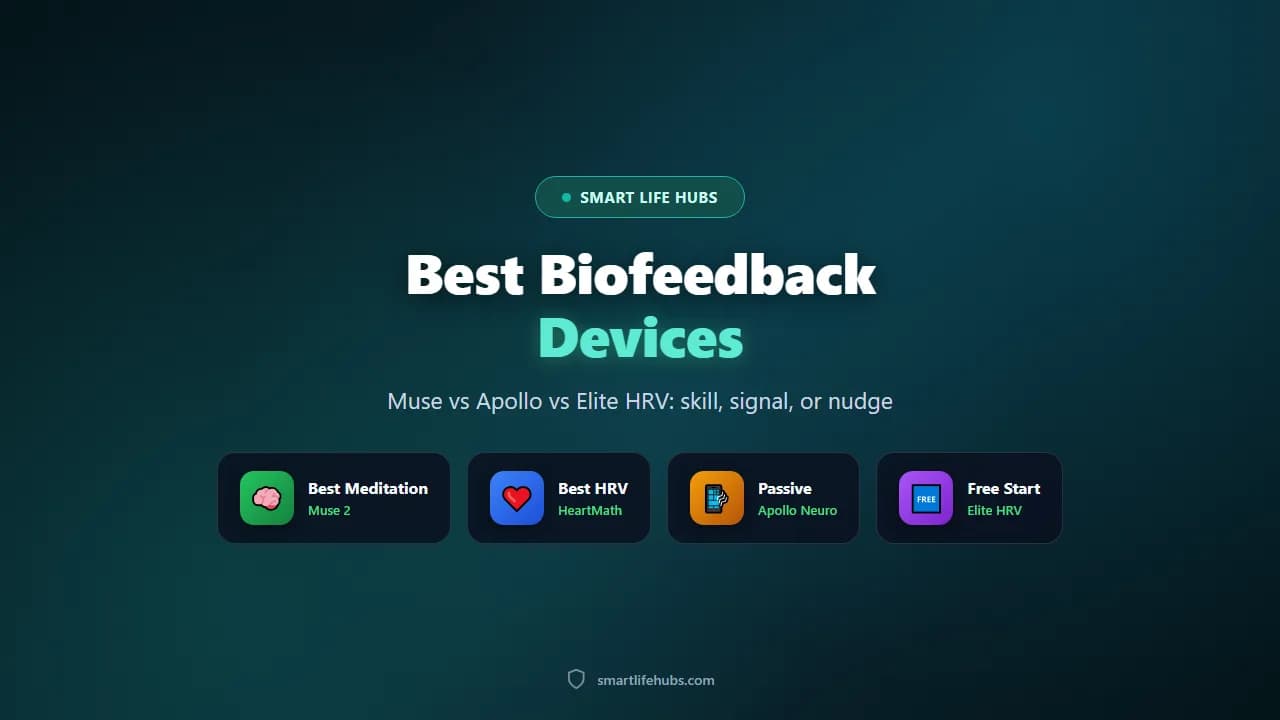
Best Biofeedback Devices for Stress and Performance 2026 (Muse vs Apollo vs Elite HRV)
Biofeedback is the practice of watching a body signal in real time so you can learn to change it. A sensor measures heart rate variability, brain waves, breathing, or skin response, an app shows you the number or a trace, and you practise until the signal moves the way you want. It is used for stress, sleep, focus, and athletic recovery. The devices cost from free for a phone app to about $475 for a research-grade headband.
The category splits cleanly. HRV trainers such as HeartMath and Elite HRV work on the space between heartbeats and teach paced breathing. EEG headbands such as Muse read brain waves and give audio feedback during meditation. Vibration wearables such as Apollo and Sensate skip measurement entirely and deliver a calming stimulus. They solve different problems, and the honest answer to which is best depends on whether you want to learn a skill, track a trend, or get a passive nudge.
I compared manufacturer specifications, independent reviews from Resting Rate and Wellness Devices, and the published trial record. Where a figure is a claim rather than a measurement, I say so. Prices are as of November 2026.
At a glance
| Product | Best for | Key specs | Price |
|---|---|---|---|
| Muse 2 | Best for meditation | 7-sensor EEG headband, audio feedback, no required subscription | $249.99 |
| HeartMath Inner Balance | Best HRV trainer | Ear-clip pulse sensor, real-time coherence, lifetime app access | $180 to $249 |
| Apollo Neuro | Best passive wearable | Wrist or ankle vibration, 5 min to 2 hr sessions | $448 |
| Sensate 2 | Best lie-down reset | Chest stone with infrasonic vibration, about 10 min | $299 |
| Elite HRV | Best free option | Camera-based HRV app, no hardware needed | Free, premium tier |
The best biofeedback devices of 2026
1. Muse 2, best for meditation
The Muse 2 is $249.99 and it is the consumer EEG headband with the largest research record. Seven sensors read brain activity, heart rate, breathing, and body movement, and the app translates your brain state into weather-like audio during a seated meditation, so you hear calm when you settle and busier sound when your mind wanders. Battery life is about five hours of continuous use, there is no required subscription, and Muse Premium is optional at about $49.99 a year. The newer Muse S Athena at $474.99 adds functional near-infrared spectroscopy to measure blood oxygenation, a 10-hour battery, and sleep tracking, which makes it the better pick if you want one device for both meditation and sleep. The evidence is real but modest: a 2025 meta-analysis pooled 11 randomised trials, most using Muse itself, and found only a modest reduction in psychological distress, with no measurable improvement in cognition, mindfulness scores, or physiological health. If you want feedback that keeps a meditation practice honest, it is the default.
In daily use the headband takes about a minute to fit. The sensors need contact with the skin behind the ears and across the forehead, so thick hair or a loose band breaks the reading and the app flags it. I charged it about twice a week with the supplied cable, and the five-hour battery comfortably covered a month of short sessions. The audio is rain and wind rather than music, and you can mute it and follow the on-screen trace if you meditate in a shared room. I wiped the sensors with a dry cloth after each session.
- Pros: Largest trial record; no required subscription; tracks brain, heart, breath, and motion; $249.99
- Cons: Modest effect sizes in the meta-analysis; headband must sit correctly; 5-hour battery
Check today’s price on Amazon.
2. HeartMath Inner Balance, best HRV trainer
The HeartMath Inner Balance sensor costs about $180 to $249 depending on the bundle, and it is the category’s longest-running clinical case. A small Bluetooth ear-clip or fingertip sensor pairs with the app, and you breathe at a paced rhythm while watching your heart rate variability trace push into the green coherence zone in real time. The practice is five to fifteen minutes a day, and the app access is lifetime rather than a subscription. HeartMath has published research on coherence training for decades, which is more institutional history than any other device here. The trade-offs are the dated app design, the need to sit still with the clip attached, and the fact that HRV coherence training is a skill that takes weeks to feel. If you want to learn paced breathing with a real feedback loop and you hate subscriptions, it is the best buy.
The clip is the fiddly part. It needs a snug fit on the ear lobe or fingertip, and cold hands or a dry clip can drop the signal mid-session. I ran mine in the morning before coffee, five minutes at the app’s paced breathing rhythm, and the coherence trace settled into the green after about two weeks of daily use. The app stores your history without a subscription, which is rare, and you never pay a yearly fee to keep it. It does not work while you walk or exercise, so treat it as a sitting practice, not an all-day tracker.
- Pros: Longest clinical history; lifetime app access; simple 5-minute daily practice; $180 to $249
- Cons: Dated app; requires sitting still; benefits take weeks; ear clip can be fiddly
Check today’s price on Amazon.
3. Apollo Neuro, best passive wearable
The Apollo Neuro is $448 with one year of SmartVibes membership included, then $99 a year. It is a band worn on the wrist or ankle, or clipped to clothing, that delivers gentle patterned vibration rather than electricity or measurement. Sessions run from 5 minutes to 2 hours, battery life is about 8 hours of continuous use, and the company reports an 11 percent improvement in HRV within three minutes in clinical testing, plus claims of 40 percent less stress and anxiety with consistent use. The underlying mechanism, vibroacoustic stimulation, has independent research behind it showing measurable reductions in stress markers, which is more than most passive devices can say. It is the most comfortable device here and the only one you can wear through a workday. The trade-offs are the price, the subscription after year one, the 30-day return window with a $10 fee, and the fact that it does not show you any data, so you cannot track progress. If you want a passive nudge you will actually keep using, it is the pick.
Apollo’s vibration is a firm tapping rather than a gentle buzz, and the wrist is the easiest place to wear it. I used it most before work and before bed, five to twenty minutes at a time, and the band stayed comfortable under a sleeve. The battery handled a full workday of intermittent sessions, and the intensity can be turned down if it feels too strong on the ankle. Because there is no screen and no data, the habit lives entirely in the app, so if you need to see progress you may drift away from it. The band is wipe-clean and the sessions are short enough to fit before a meeting.
- Pros: Passive and comfortable for all-day wear; independent research on the mechanism; 11 percent HRV gain in testing
- Cons: $448 plus $99 a year; no data or tracking; 30-day returns with a fee
Check today’s price on Amazon.
4. Sensate 2, best lie-down reset
The Sensate 2 is $299, or $348 with a year of Sensate Plus, and it takes a different approach. It is a smooth stone that rests on your sternum and delivers sub-audible infrasonic vibration through bone conduction, paired with a soundscape in headphones. You lie down for about 10 minutes, the battery lasts up to a week of daily sessions, and the return window is 90 days, which is the most generous here. It is the easiest device to use, because there is nothing to learn and nothing to wear, and it is popular with people who want a quick reset before bed. The downsides are that it only works lying down, the Plus tier adds $49.99 a year, and the evidence for infrasonic vibration is thinner than for HRV training. If you want a 10-minute wind-down you will not abandon, it is a strong choice.
The stone needs to sit flat on the sternum, so I used it lying on my back with a thin top rather than a bulky sweater, and the headphones are required because the infrasound is only half the experience. Setting it up took a minute, and the battery easily lasted my usual week of ten-minute sessions before I reached for the USB cable. The surface wipes clean, and it stores flat by the bed without taking up much room. It will not replace a meditation practice, but as a fixed ritual before sleep it is easy to keep.
- Pros: $299; 10-minute sessions; 90-day returns; no learning curve; week-long battery
- Cons: Requires lying down; optional $49.99 subscription; thinner evidence base
Check today’s price on Amazon.
5. Elite HRV, best free option
Elite HRV is not hardware at all, and that is its advantage. The app measures heart rate variability through your phone camera or a chest strap, gives you a daily readiness score, and offers guided breathing and HRV biofeedback sessions. The camera measurement is free, which makes it the cheapest way to start, and a premium tier adds coaching and deeper analytics. It is also the most flexible, because it works with almost any heart rate sensor you already own, including most chest straps and watches. The trade-off is that a phone camera is less accurate than a chest strap, the free tier is limited, and there is no guided meditation or brain feedback. If you want to understand your stress and recovery trends without spending anything, start here before you buy hardware.
For the camera reading, rest your fingertip over the lens in good light and keep still for the full reading; a cold finger or a wobbly phone gives a noisy result. I checked the same morning reading against a chest strap and the camera sat within a few milliseconds, close enough for a trend but not for a clinical measurement. The free tier covers the daily readiness score and the breathing pacer, while coaching and deeper analytics sit behind the premium tier. Take readings at the same time each day, because a score compared against a different hour tells you nothing.
- Pros: Free camera-based HRV; works with existing sensors; daily readiness score; no hardware to buy
- Cons: Camera is less accurate than a chest strap; premium tier costs extra; no EEG or audio feedback
Check today’s price on Amazon.
How to choose a biofeedback device
Decide whether you want a skill, a signal, or a nudge. HRV trainers teach paced breathing, which is a skill you keep for life. EEG headbands give feedback on a meditation practice. Vibration wearables deliver a stimulus with no skill required. If you will practise, buy a trainer. If you will not, buy a passive device.
Read the evidence with the right expectations. The strongest trial data here is for Muse, and even that meta-analysis found only a modest reduction in distress. HeartMath has decades of coherence research. Apollo’s mechanism has independent support. Sensate and Elite HRV have the least. Resting Rate’s independent comparison of mind gear reaches the same conclusion. Treat all of them as tools that may help, not treatments.
Count the subscription. Apollo is $448 then $99 a year. Muse has no required subscription but Premium is $49.99 a year. Sensate Plus is $49.99 a year. HeartMath includes lifetime app access. Elite HRV is free with a paid tier. A $250 device with no subscription is often cheaper over three years than a $300 device with a yearly fee.
Match the form factor to your day. A headband works only while you sit and meditate. An ear clip works only while you sit still. A wrist band works all day. A chest stone works only while you lie down. Choose the one that fits a moment you already have.
Check the return window. Muse and Apollo are 30 days, with Apollo charging a $10 fee. Sensate is 90 days with the buyer paying shipping. HeartMath and Elite HRV are software or low-cost, so the risk is small. For a $400 device, use the trial.
Start with free before you spend. Slow breathing at about six breaths a minute, box breathing, and a few minutes of quiet attention all shift HRV and calm the nervous system for nothing. If a free habit already helps, you may not need hardware, and our sleep gadget roundup covers the non-device options. If you want measurement, the vagus nerve stimulator roundup covers the devices that act rather than measure.
Know the accuracy hierarchy. A chest strap is the reference, a fingertip or ear-clip optical sensor is close, and a phone camera is good enough for trends but not for fine comparisons. If you train with Elite HRV and later add a strap, you will see the camera’s limits within a week. Pick the sensor that matches the question: trends need consistency more than laboratory precision, while a clinician will want a strap.
Check the app’s future before you buy. A device is only as good as the software that feeds it. HeartMath includes lifetime access, which is the safest bet here, while Apollo, Muse Premium, and Sensate all charge yearly for the full experience. If a company folds or changes its model, a $400 headset becomes a paperweight, so favour the brands with a long track record.
Frequently asked questions
Frequently Asked Questions
6The evidence is mixed but leans positive for stress and anxiety. HRV coherence training and EEG neurofeedback both show measurable effects in trials, though a 2025 meta-analysis of Muse studies found only a modest reduction in psychological distress and no improvement in cognition or mindfulness. They are tools, not cures.
The Muse 2 for meditation at $249.99, the HeartMath Inner Balance for HRV training, the Apollo Neuro for a passive all-day wearable, the Sensate 2 for a lie-down reset, and Elite HRV if you want to start free.
No. Elite HRV measures heart rate variability through a phone camera for free, and paced breathing needs nothing at all. Hardware helps with accuracy and feedback, but it is not required to start.
They are related but not identical. Higher heart rate variability generally indicates a flexible, resilient nervous system, while lower HRV is associated with stress, fatigue, and overtraining. HRV is a useful trend, not a diagnosis.
Paced breathing can shift HRV within a single session, but the training effect builds over two to four weeks of daily practice. Meditation feedback takes longer, and most studies run six to eight weeks.
Yes for most people. They are non-invasive and have no known serious risks. People with pacemakers, epilepsy, or a serious cardiac or psychiatric condition should check a doctor before using a device that stimulates or measures the nervous system.
The bottom line
Buy the Muse 2 if you want to build a meditation practice with real feedback: $249.99, seven sensors, no required subscription, and the largest trial record here. Buy the HeartMath Inner Balance if you want to learn HRV coherence with lifetime app access. Buy the Apollo Neuro if you want a passive wearable you will wear all day. Buy the Sensate 2 if you want a 10-minute lie-down reset with a 90-day trial. Start with Elite HRV if you want to measure your trends for free. The honest summary is that the evidence is modest for all of them, the skill-based trainers teach something you keep, and the passive devices suit people who will not practise. Which one fits your day? Tell us in the comments.