Best Red Light Therapy Panels of 2026 (Joovv vs Mito vs PlatinumLED)
A red light therapy panel is a flat array of LEDs that shines red and near-infrared light onto your skin, and the claims range from better skin and faster recovery to better sleep and less joint pain. The honest position is that the evidence is real but modest, the marketing is far ahead of it, and the difference between the three big brands comes down to irradiance, wavelength range and how much you trust the numbers on the box.
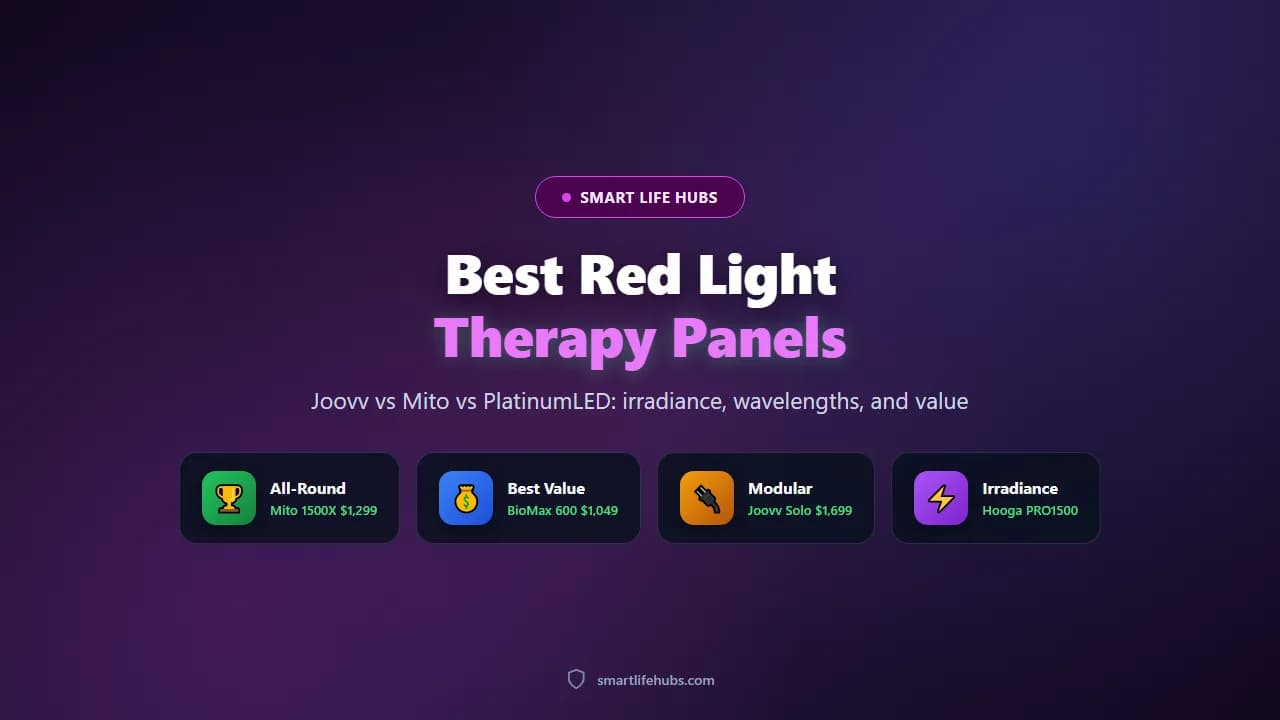
Prices run from about $250 for a small panel to $1,699 for a Joovv Solo 3.0, with the strongest value clustered between $1,000 and $1,300. The PlatinumLED BioMax 600 at $1,049 offers the widest wavelength range and a three-year warranty. The Mito Red MitoPRO 1500X at $1,299 is the best all-round pick, and the Joovv Solo 3.0 at $1,699 is the most modular but the least verified on output.
I pulled MoveWell’s spec-verified comparison, ONDA Life’s head-to-head, Light Therapy IQ’s spectrometer testing and BankrollZen’s ranked roundup. Where a figure is a claim rather than a measurement, I say so. Prices are US street prices as of November 2026.
At a glance
| Product | Best for | Key specs | Price |
|---|---|---|---|
| PlatinumLED BioMax 600 | Best value | 7 wavelengths from 480 to 1060 nm, about 190 mW/cm2 at 6 in, 3-year warranty | $1,049 |
| Mito Red MitoPRO 1500X | Best all-round | 6 wavelengths from 590 to 850 nm, more than 160 mW/cm2 at 6 in, 3-year warranty | $1,299 |
| Joovv Solo 3.0 | Best modular | 2 wavelengths at 660 and 850 nm, about 100 mW/cm2, modular stacking | $1,699 |
| PlatinumLED BioMax 900 | Best measured output | 7 wavelengths, 90.3 mW/cm2 measured average at 6 in | About $1,200 to $1,300 |
| Hooga PRO1500 | Best irradiance value | 2 wavelengths at 660 and 850 nm, about 189 mW/cm2 at 6 in | About $1,199 |
The best red light therapy panels of 2026
1. PlatinumLED BioMax 600, best value
The PlatinumLED BioMax 600 costs $1,049 and it is the panel that gives you the most spectrum for the money. It offers seven wavelengths from 480 to 1060 nanometres, about 190 mW/cm2 at 6 inches, a 90 degree beam angle, a three-year warranty and a 60-day return window. ONDA Life names it the price winner, at $650 less than the Joovv Solo 3.0, and BankrollZen rates it 4.6 out of 5 as the best performance per dollar.
The trade-offs are the third-party data and the regulatory status. Light Therapy IQ’s spectrometer testing found a 2024 conference paper measured the BioMax 300 below its advertised irradiance, though that paper was not peer reviewed and gave no figures, and ONDA Life found no FDA registration for the BioMax 600 while the other two brands list their devices. Registration is not clearance, but it is a difference worth knowing.
- Pros: $1,049; 7 wavelengths; about 190 mW/cm2 at 6 in; 3-year warranty; 60-day returns
- Cons: Irradiance measured below advertised in one unpublished paper; no FDA registration found
Check today’s price on Amazon.
2. Mito Red MitoPRO 1500X, best all-round
The Mito Red MitoPRO 1500X costs $1,299 and it is the pick ONDA Life recommends for most buyers in 2026, because it combines six wavelengths from 590 to 850 nanometres, more than 160 mW/cm2 at 6 inches, a three-year warranty and a 60-day trial. MoveWell found the most output data for the money here, with LightLab testing showing the MitoPRO 300X at an average 38.2 and peak 55.9 mW/cm2 at 6 inches, and the 1500X at an average 53.5.
The trade-offs are that Mito’s lab reports were paid for by Mito, and the panel is a large single unit at 43 by 10 inches rather than a modular stack. For full-body coverage the 1500X is the best value per square inch in this roundup.
- Pros: $1,299; 6 wavelengths; more than 160 mW/cm2; 3-year warranty; 60-day trial
- Cons: Brand-funded lab data; large single panel, not modular
Check today’s price on Amazon.
3. Joovv Solo 3.0, best modular
The Joovv Solo 3.0 costs $1,699 and it is the most polished product here, with a modular system that stacks vertically so you can build a full-body setup over time. It uses two wavelengths at 660 and 850 nanometres and rates above 100 mW/cm2 at the LED surface. ONDA Life names it the winner on coverage and modularity, and BankrollZen rates it 4.7 out of 5 as the best overall panel.
The trade-offs are price and output. Light Therapy IQ’s spectrometer testing measured the Solo 3.0 at an average 59.2 mW/cm2, the lowest of the large panels it tested, which works out at roughly $16 to $20 per watt of measured output against about $6.50 to $7 per watt for the PlatinumLED BioMax 900. MoveWell also found no wavelengths in nanometres or irradiance published on Joovv’s product pages at the time of checking.
- Pros: Modular stacking; strong brand support; 2-year warranty; 60-day returns
- Cons: $1,699; lowest measured irradiance of the large panels; only two wavelengths
Check today’s price on Amazon.
4. PlatinumLED BioMax 900, best measured output
The PlatinumLED BioMax 900 costs about $1,200 to $1,300 and it is the panel Light Therapy IQ names the best measured output, with 90.3 mW/cm2 average at 6 inches and the smallest overclaim gap in its test at 33 percent. It keeps the seven-wavelength range and the three-year warranty, in a 36 by 12 inch panel.
The trade-off is coverage per dollar. It measures about $6.45 to $6.99 per watt of measured output, which is competitive, but the Joovv Solo 3.0 in the same test band works out at $16.47 to $20 per watt. If you want the most verified output for your money, this is the panel.
- Pros: About $1,200 to $1,300; 7 wavelengths; 90.3 mW/cm2 measured; 3-year warranty
- Cons: Larger and heavier; fewer smart features than Joovv
Check today’s price on Amazon.
5. Hooga PRO1500, best irradiance value
The Hooga PRO1500 costs about $1,199 and it is the irradiance value pick, with about 189 mW/cm2 at 6 inches in a 36 by 8.6 inch panel. It uses two wavelengths at 660 and 850 nanometres and rates 4.4 out of 5 in BankrollZen’s roundup, which names it the best irradiance value.
The trade-off is the narrow spectrum. Two wavelengths covers the red and near-infrared bands that most of the research uses, but you miss the wider range that PlatinumLED and Mito offer. If you want raw power on a budget, this is the pick.
- Pros: About $1,199; about 189 mW/cm2 at 6 in; large panel; strong value
- Cons: Only two wavelengths; less brand history than Joovv or Mito
Check today’s price on Amazon.
Living with a red light panel
The first thing you learn is that consistency beats intensity. Ten minutes three times a week for a month will tell you more about whether red light works for you than a single heroic session, and the panels that get used are the ones that hang on a wall or stand in a corner rather than live in a box.
The second thing is that distance and angle matter more than you expect. Sit or stand at the distance the panel specifies, face it squarely and treat one area at a time rather than sweeping the beam around. Most people start too far away and wonder why nothing happens.
The third thing is the eye protection. The LEDs are bright enough to be uncomfortable, and most panels ship with goggles. Use them, and do not assume that because the light feels pleasant you can stare at it.
The fourth is that the benefits, if they come, are gradual and easy to miss. People tend to notice a difference in how their skin looks or how a joint feels after several weeks, and then stop noticing because it has become normal. Keeping a simple note of how you felt at the start makes the change visible.
Finally, think about where the panel will live. A panel that needs assembly and a floor stand in a spare room will lose to a smaller one that hangs by the mirror, because the barrier to use is what decides whether an expensive device becomes part of your routine.
And be patient. The panels that seem to do nothing for three weeks are often the ones people thank six months later, and the ones who quit after a fortnight never find out what it might have done for them.
Patience is the real requirement here, more than the hardware.
How to choose a red light panel
Check the irradiance and the distance. Irradiance falls off fast with distance, so a figure quoted at the LED surface is not comparable with one at 6 inches. Look for mW/cm2 measured at 6 inches or further, because that is the distance you will actually use.
Be sceptical of brand-funded testing. Mito’s lab reports were paid for by Mito, and Light Therapy IQ’s independent spectrometer testing found gaps between advertised and measured output across the category. Independent measurement is worth more than a product-page number.
Match the panel to the area you want to treat. A small panel suits the face and a joint, a large panel suits the back and legs, and a modular system lets you grow. Full-body coverage needs either a very large panel or two panels.
Think about the dose, not just the power. A session dose is irradiance multiplied by time, so a lower-powered panel used for longer can deliver a similar dose to a high-powered one used briefly. MoveWell calculated that the MitoPRO 300X at its lab-measured average reaches about 9 J/cm2 in roughly 4 minutes.
Check the warranty and returns. The three main brands offer two to three year warranties and 60-day return windows, which matters on a $1,000 purchase. Confirm the return terms before you buy, because return shipping on a large panel is not cheap.
Keep expectations realistic. The research supports modest benefits for skin, joint pain and recovery, and the marketing goes well beyond it. Red light is a plausible addition to a routine rather than a treatment that will transform anything on its own.
Do not stare at the panel. Near-infrared and red LEDs are bright, and most panels ship with eyewear. Use it, and keep the panel at the recommended distance rather than pressing it against your skin.
Think about the rest of the kit. Our PEMF mat guide covers a different kind of home therapy, and our recovery slides roundup covers the simpler end of recovery kit.
Frequently asked questions
Frequently Asked Questions
6The Mito Red MitoPRO 1500X at $1,299 for most buyers, with six wavelengths, more than 160 mW/cm2 and a 60-day trial. The PlatinumLED BioMax 600 at $1,049 if you want the widest spectrum for less, and the Joovv Solo 3.0 at $1,699 if you want a modular system.
For skin, joint pain and recovery, the evidence is modest but real, and the marketing is well ahead of the research. If you will use a panel three to five times a week, it is a reasonable purchase. If you expect a transformation, you will be disappointed.
Most dosing guidance assumes 6 inches or further, and irradiance falls off quickly with distance, so check the distance attached to any irradiance figure. Closer is not better beyond a point, because the dose per session matters more than the intensity.
Typically 3 to 10 minutes per area, depending on the panel’s irradiance. A panel at about 50 mW/cm2 needs longer than one at 150 mW/cm2 to deliver the same dose.
Only if modularity matters to you. Light Therapy IQ measured the Solo 3.0 at an average 59.2 mW/cm2, the lowest of the large panels tested, working out at roughly $16 to $20 per watt against about $6.50 to $7 for the PlatinumLED BioMax 900.
All three main brands say their panels are within safety guidelines, and Mito publishes near-zero detectable EMF figures from its own testing. If EMF is a concern for you, ask the brand for its test report rather than relying on the product page.
The bottom line
Buy the Mito Red MitoPRO 1500X if you want the best all-round panel: $1,299, six wavelengths, more than 160 mW/cm2 and a 60-day trial. Buy the PlatinumLED BioMax 600 at $1,049 if you want the widest spectrum and the best value, the BioMax 900 at about $1,200 to $1,300 if you want the best measured output, and the Hooga PRO1500 at about $1,199 if you want raw irradiance for the price. Buy the Joovv Solo 3.0 at $1,699 only if you want a modular system you can expand, because it measured the lowest irradiance per dollar in independent testing. Light Therapy IQ’s spectrometer-tested panel ranking reached the same conclusion on output per dollar. The honest summary is that the category’s advertised numbers are unreliable, the independent measurements favour PlatinumLED and Mito on value, and no panel will do more than a modest amount for you however much you spend. Which matters more to you, spectrum or raw power? Tell us in the comments.