LARQ Bottle PureVis 2 Review 2026: Self-Cleaning UV Water Bottle Tested
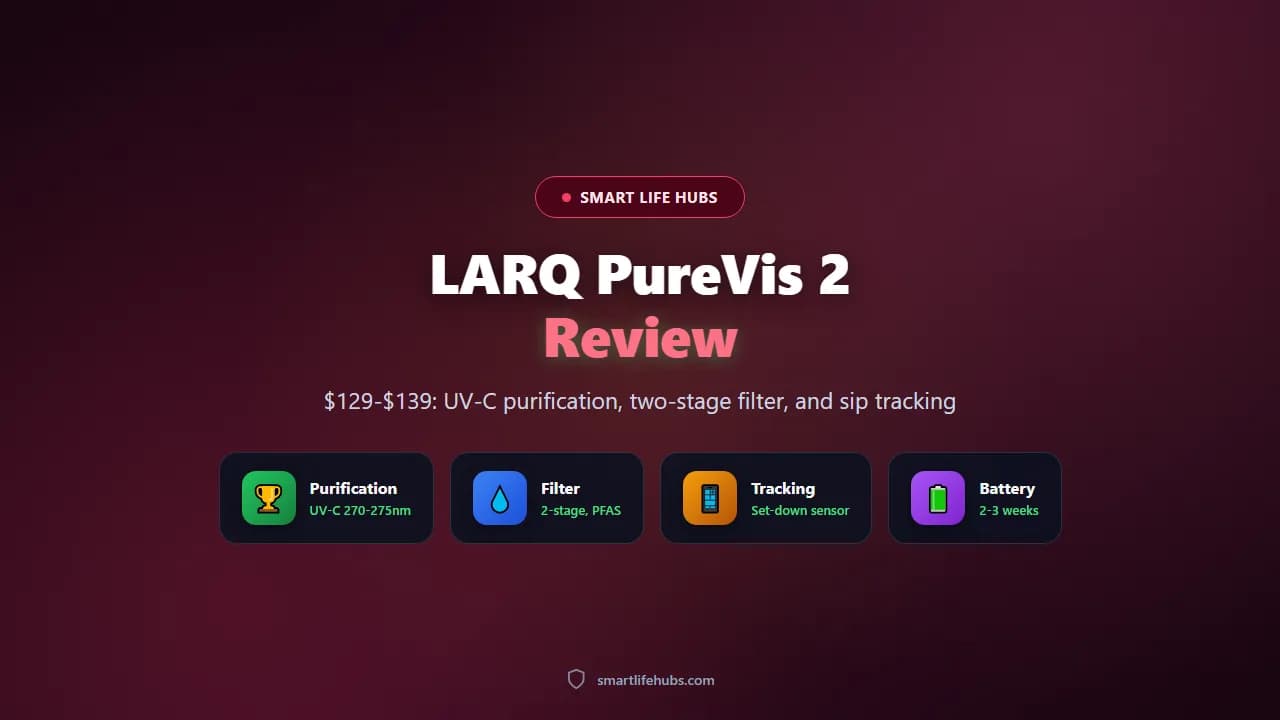
The LARQ Bottle PureVis 2 is a stainless steel bottle that does four things at once: it filters your water, purifies it with UV-C light, keeps it cold for 24 hours, and tracks how much you actually drank. It costs $129 for 23 ounces or $139 for 34, which makes it one of the most expensive bottles you can buy, and the case for it rests on the purification rather than the tracking. The UV-C LED in the cap runs a 60 second cycle on demand or a 10 second cycle automatically every two hours, and LARQ says it removes up to 99.99 percent of bacteria such as E. coli and salmonella.
It is a genuinely good bottle and an expensive one. The purification works, the insulation works, and the app tracking is useful once you accept that you must set the bottle down to log a sip. What you are buying is a bottle that stops smelling and lets you refill from a dubious tap, and the hydration tracking is a bonus rather than the main event.
I pulled CNET’s and Gizmodo’s reviews, Good Housekeeping’s travel award testing, Foundeen’s measured battery and UV testing, and LARQ’s published specifications. Where a figure is a claim rather than a measurement, I say so. Prices are as of November 2026.
At a glance
| Product | Best for | Key specs | Price |
|---|---|---|---|
| LARQ PureVis 2 | Best overall | UV-C plus two-stage filter, 23 or 34 oz, app tracking, 2 to 3 weeks battery | $129 to $139 |
| HidrateSpark PRO 2 | Best tracker only | Weight-based sensor, 21 oz, Apple Health sync, no purification | $79.99 |
| LARQ PureVis | Cheapest UV option | UV-C cap, no tracking sensor, insulated or plain | About $99 |
| WaterH BOOST | Best value tracker | 32 oz, motion tracking, LED ring, about 30 days battery | $43.99 to $54.99 |
| ICEWATER 3-in-1 B2 | Cheapest nudge | 18 oz, glow, lights and speaker, no tracking | $19.99 |
LARQ PureVis 2 in detail
The purification, which is the point
The PureVis 2 has two stages. A UV-C LED in the cap emits light at 270 to 275 nanometres, the wavelength used in hospital and municipal water treatment, and a single press runs a 60 second cycle delivering 12 millijoules per square centimetre. An adventure cycle runs for three minutes at above 30, for water you are less sure about. The cap also runs a 10 second cycle automatically every two hours, which is aimed at the biofilm that makes bottles smell. CNET reported that the two stages remove 99.999 percent of salmonella and 99.99 percent of E. coli in LARQ’s published lab testing.
The second stage is a filter straw. The Essential filter reduces chlorine, PFAS including PFOA and PFOS, and pharmaceuticals, while the Advanced filter adds lead, HAA5 and particulates. Filters last about 25 gallons or two months and cost $29.95 for a three-pack. One important limitation: UV-C works on clear water only, so muddy or cloudy water still needs a proper filter or boiling.
The practical benefit is that the bottle does not develop the musty smell most reusable bottles get, and you can refill from a gym tap or a trailhead without worrying. For anyone who has fought bottle odour, that alone is worth considering.
Build, insulation, and daily carry
The body is food grade 18/8 stainless steel with a double-wall vacuum, and it holds cold for up to 24 hours and hot for 12. It measures 288 millimetres tall by 83 wide and weighs 439 grams empty, which is heavier than a normal bottle because of the battery in the cap, and Good Housekeeping’s tester noted the extra heft. It comes in 23 and 34 ounce sizes, plus 680 millilitre and 1 litre versions in some markets, and the shape fits most car cup holders. A detachable handle makes it easier to carry, and the cap is BPA-free plastic.
The bottle is not designed to be submerged in the dishwasher, and the cap electronics should be wiped rather than soaked. The filter straw is replaceable, which is the main routine maintenance.
Hydration tracking and the app
Tracking is the feature that separates the PureVis 2 from the original PureVis. A sensor in the cap measures the water level inside the bottle each time you set it down flat on a level surface after drinking, and the app logs the difference, to a tenth of an ounce. That means the tracking is passive rather than continuous, and it needs you to put the bottle down rather than leaving it in your hand. Good Housekeeping found the tracking genuinely motivating even though the app did not always sync reliably, and Gizmodo found the level recalibration worked on every sip and reclose.
The app sets a personalised daily target from your age, weight and exercise level, sends drink reminders, and shows streaks, money saved on bottled water and your reduced carbon footprint. It also reports filter performance, filter age and battery level. There is no subscription. It syncs two-way with Apple Health on iPhone, and Android users report more connectivity problems than iOS users, which is worth knowing if you are on Android.
One accuracy caveat: ice displaces water and confuses the sensor slightly, so a bottle full of ice will under-report. If you drink mostly iced water, expect the total to run low.
Battery, and the sealed cap
LARQ claims two to three weeks per charge over USB-C, and some marketing says a month. Foundeen’s measured test found closer to ten days with the auto-clean cycle running every two hours, which is the honest number to plan around. The cap blinks yellow when the battery is low, and you can see the level in the app.
The battery is sealed inside a glued cap and is not replaceable. That is the design’s weak point: when the battery degrades, the cap is the product and the cap is effectively disposable. At $129 to $139, a bottle whose electronics have a finite life is a harder sell than one with a replaceable battery, and it is worth weighing against a cheaper bottle you can replace.
The honest drawbacks
The price is the first problem. At $129 to $139, the PureVis 2 costs more than a HidrateSpark PRO 2 and a separate filter straw combined, and the tracking it offers is less precise than the HidrateSpark’s weight-based sensor. The second is the filter, which is an ongoing cost of about $15 a month if you change it every two months. The third is the app, which Good Housekeeping found unreliable at syncing and which Android users report as worse. The fourth is the sealed, non-replaceable battery.
There is also a question of what you are solving. If your tap water is good and your bottle does not smell, none of the purification matters, and a $45 tracker does the hydration job better. The PureVis 2 earns its price only if you refill from uncertain sources, you hate washing bottles, or you travel somewhere the water is questionable.
How it compares
The HidrateSpark PRO 2 at $79.99 is the better choice if you only want tracking: its weight-based sensor measures volume directly, it syncs to Apple Health and Fitbit, and it costs $50 less. The original LARQ PureVis at about $99 keeps the UV-C purification and loses the tracking sensor and the filter, so it suits someone who wants clean water without the app. The WaterH BOOST at $43.99 to $54.99 is the value tracker, and the ICEWATER 3-in-1 at $19.99 is a reminder light with no tracking at all.
Living with it daily
The first thing you notice is the cap. It is bulkier than a normal lid because it houses the UV diode, the sensor and the battery, and the whole bottle is 439 grams empty, which is noticeable on a long walk. The swig-top straw lid is comfortable to drink from one handed, and the detachable handle helps when you are carrying it between stops.
The second thing is the two-hour cycle. It is silent and invisible, and after a few days you stop thinking about it. That is the design working: the purification happens in the background rather than as a task you remember. The cap glows when it runs and blinks yellow when the battery is low, and you can silence the light in the app for quiet hours, which Foundeen’s tester used to stop it glowing at three in the morning.
The third thing is the filter straw. You will notice a slight difference in taste if your tap water is heavily chlorinated, and you will notice the app nudging you when the filter approaches the end of its life. Budget for it: at $29.95 for a three-pack and a two month change interval, that is roughly $15 a month if you use the bottle daily, which over two years adds about as much again as a cheaper bottle.
The fourth thing is the tracking habit. Because the sensor logs when you set the bottle down, leaving it in your hand while you work means those sips are not counted. Most owners adapt within a week and put the bottle on the desk between sips. If you tend to carry a bottle around, expect the total to under-report.
Is the LARQ PureVis 2 worth $129?
Buy it if you refill from questionable sources. The combination of UV-C purification and a two-stage filter is the reason this bottle exists, and it is the best implementation available. If you hike, travel or use gym taps, it removes a real worry.
Buy it if you hate bottle smell. The automatic two-hour cycle keeps the interior clean without scrubbing, and that is a genuine quality-of-life improvement over a normal reusable bottle.
Buy the HidrateSpark PRO 2 if you only want tracking. At $79.99 it measures intake more accurately and syncs to more health apps, and it costs $50 less.
Buy the original LARQ PureVis if you want UV without the app. At about $99 you keep the purification and lose the tracking and the filter, which is a better deal if you do not care about the data.
Buy the WaterH BOOST if you are on a budget. At $43.99 it tracks intake and holds 32 ounces, which is more capacity than the LARQ for a third of the price.
Do not buy it if your water is already clean and you are disciplined about washing. You would be paying $140 for features you do not need, and the sealed battery will age regardless.
Think about the rest of the hydration kit. Our smart water bottle roundup covers the alternatives, and our reusable bottle guide covers the non-smart options.
Frequently asked questions
Frequently Asked Questions
6It is $129 for the 23 ounce bottle and $139 for the 34 ounce. Replacement filters cost $29.95 for a three-pack, and each lasts about 25 gallons or two months.
Yes. A UV-C LED in the cap runs a 60 second cycle on demand or a 10 second cycle automatically every two hours, and LARQ’s published testing reports removal of up to 99.999 percent of salmonella and 99.99 percent of E. coli. It works on clear water only.
Yes. A sensor in the cap measures the water level each time you set the bottle down flat after drinking, and the LARQ app logs the difference to a tenth of an ounce. It needs the bottle to be set down, and ice can confuse the reading.
LARQ claims two to three weeks per USB-C charge, with some marketing saying a month. Independent measured testing found closer to ten days with the auto-clean cycle running.
Yes, if you refill from uncertain water sources, you travel, or you dislike washing bottles. It is harder to justify if your tap water is clean and you only want hydration tracking, because the HidrateSpark PRO 2 does that better for $50 less.
No. The battery is sealed inside a glued cap and is not replaceable, so when it degrades the cap is effectively disposable. That is the main long-term weakness of the design.
The bottom line
The LARQ Bottle PureVis 2 is the best self-cleaning smart bottle you can buy, and it is expensive. You get UV-C purification that runs every two hours or on demand, a two-stage filter for chlorine, PFAS and pharmaceuticals, double-wall insulation for 24 hours of cold, app tracking that logs each time you set the bottle down, and a USB-C battery that LARQ says lasts two to three weeks. The weaknesses are the $129 to $139 price, the ongoing filter cost, app sync reliability, a sensor that ice confuses, and a sealed non-replaceable battery. Buy it if you refill from questionable sources or hate bottle smell. Buy the HidrateSpark PRO 2 if you only want tracking, the original LARQ PureVis at about $99 if you want UV without the app, or the WaterH BOOST at $45 if you want the best value. CNET’s tested self-cleaning bottle roundup reached the same conclusion on the PureVis range. Have you tried a self-cleaning bottle? Tell us in the comments.